 |
Science Frontiers ONLINE No. 113: Sep-Oct 1997 |
|
| 
|
A VANISHED PLANET?
Almost every week, it seems, a new Texas-sized object is discovered in the outer solar system. In the inner solar system, however, some astronomers are finding "holes" where planets seem to have been ejected by unknown forces. D. Christodoulou, Louisiana State University, found one such "hole" serendipitously. He was studying how the sun and the planets might have condensed from the (hypothesized) cloud of primordial gas and dust. Factoring in gravity, rotation, and magnetic fields, he found the cloud condensing in concentric rings at just the right locations for protoMercury, proto-Venus, and proto-earth. The fourth ring, however, did not correspond to any existing planet, and the position of proto-Mars was off the mark. But the asteroids and outer planets fell rather neatly into place.
The implication of these calculations is that some turmoil in the early inner solar system cast out one planet and dislocated Mars.
(Hecht, Jeff; "Did Extra Planet Vanish into Outer Space?" New Scientist, p. 18, June 14, 1997.)
Comment. These are sour notes in the "music of the spheres," but don't be overly concerned; these are just calculations based upon many assumptions.
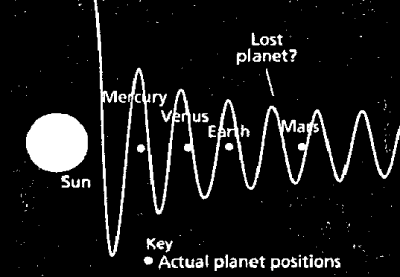 | Calculated positions of rings of condensed dust and gas compared to actual planet locations. |