 |
Science Frontiers ONLINE No. 111: May-Jun 1997 |
|
| 
|
Why Some Sands Sing, Squeak, and Boom
Singing sands and booming dunes have aroused the curiosity of explorers and beachgoers for over a century. Sand Mountain, in Nevada, is noted for its energetic thunderings. (SF#47/214) Manchester, Massachusetts, has its "singing beach." (ESP14 in Anomalies in Geology) But, common as these "sonorous" sands are, the exact mechanism of sound production remains a mystery.
D.E Goldsack and colleagues, at Laurentian University, Canada, have reported some advances in our understanding of this classical anomaly.
- The group discovered that they could make ordinary sand musical by repeated grinding, polishing, and removal of fines. Given sufficient processing, ordinary sand that is merely "noisy" when shaken can be made to "sing."
- Singing sand has a unique infrared signature: a broad band stretching from 3,700 to 2,800 cm-1 . This is probably due to clusters of water molecules in an amorphous silica layer on the surfaces of the sand grains.
- Taking a clue from the infrared spectrum, Goldsack et al shook commercially available silica gel in a bottle and heard the familiar tones of singing sand!
Their conclusion is that for sand to sing the particles must be coated with naturally (or artificially) created silica gel.
(Goldsack, Douglas E., et al; "Natural and Artificial 'Singing' Sands," Nature, 386:29, 1997. Also: Cohen, Philip; "Desert Dunes Sing Silica's Song," New Scientist, p. 17, March 8, 1997.)
Comment. The fundamental mystery survives. Goldsack admits no insights as to exactly how muscial sands find their "voices."
The subject of musical sand is explored in considerable depth at ESP14 in Anomalies in Geology. Ordering information here.
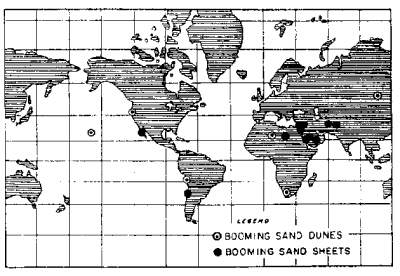 | Locations of the more prominent musical sands and booming dunes. (Adapted from: Geological Society of America, Bulletin, 87:483, 1976). |