Home Page Science Frontiers
ONLINE

No. 105: May-Jun 1996

Issue Contents


Other pages


Other Interesting Sites


Eight Little Craters All In A Row

The recent impact upon Jupiter of a procession of chunks from Comet Shoemaker-Levy 9 has encouraged geologists to look for crater chains here on earth. Such have been spotted on the moon, and it is unlikely the earth escaped such bar rages. Of course, older terrestrial craters are harder to identify due to the ceaseless geological activity here on earth.

In the first 1996 number of Geophysical Research Letters, M.R. Rampino and T. Volk describe a possible swath of meteoric devastation across the North American Midwest.

"Eight circular geologic structures ranging from about 3 to 17 km in diameter, showing evidence of outwarddirected deformation and intensive brecciation, lie within a linear swath stretching about 700 km across the United States from southern Illinois through Missouri to eastern Kansas. Based on their similar geological characteristics and the presence of diagnostic and/or probable evidence of shock, these structures, once classified as 'crypto volcanic' or 'cryptoexplosion' structures, are more confidently ascribed to hypervelocity impact. No other similar occurrence of aligned features is known, and we calculate the probability of a chance alignment to be less than 10- 9 ."

The craters are all roughly the same age: 310-330 million years. Rampino and Volk suspect they were formed all at once by a string of asteroids or comets.

(Rampino, Michael R., and Volk, Tyler; "Multiple Impact Event in the Paleozoic: Collision with a String of Comets or Asteroids?" Geophysical Research Letters, 23:49, 1996)

Comment. We cataloged a possible chain of meteorite scars in Argentina, near Rio Cuarto, in SF#80.
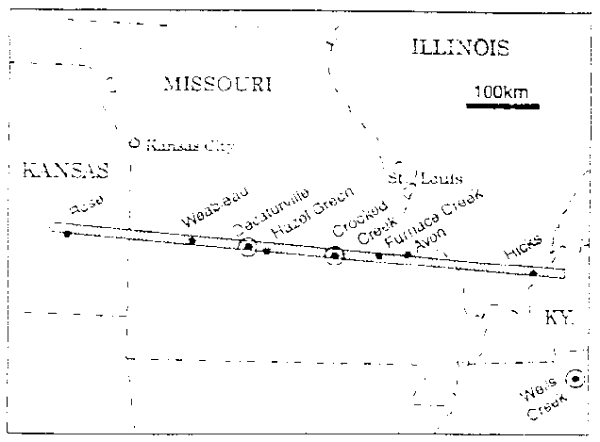
Linear chain of impact structures in the North American Midwest
Linear chain of known and probable impact structures across the North American Midwest.

From Science Frontiers #105, MAY-JUN 1996. © 1996-2000 William R. Corliss

Science Frontiers Sourcebook Project Reviewed in:

Quotes

  • "A sourcebook of unexplained phenomena is therefore a valuable addition to a collection of scientific literature. William R. Corliss has provided this in the past with his source books of scientific anomalies in several subjects, and now he has provided it for astronomy. He has done an excellent job of collecting and editing a large amount of material, taken in part from scientific journals and in part from scientific reporting in the popular or semi-scientific press." -- "The Mysterious Universe: A Handbook of Astronomical Anomalies", reviwed by Thomas Gold, Cornell University, in Icarus, vol.41, 1980

  • "An interesting, systematic presentation of unusual weather [..] This book is recommended for a general audience" --"Corliss, William R., Tornados, Dark Days, Anomalous Precipitation, and Related Weather Phenomena, Sourcebook Project, 1983.", revieweed in Choice, September 1983
  • "..the science is necessarily somewhat speculative, but Corliss's symthesis is based on reputable sources." -- "Corliss, William R. (Compiler). Lightning, Auroras, Nocturnal Lights, and Related Luminous Phenomena" reviwed by Joseph M. Moran, Univ. of Wisconsin in Science Books and Films, Sep/Oct 1983

  • "Before opening the book, I set certain standards that a volume which treads into dangerous grounds grounds like this must meet. The author scrupulously met, or even exceeded those standards. Each phenomenon is exhaustively documented, with references to scientific journals [..] and extensive quotations" -- "Book Review: The moon and planets: a catalog of astronomical anomalies", The Sourcebook Project, 1985., Corliss, W. R., Journal of the Royal Astronomical Society of Canada, Vol. 81, no. 1 (1987), p. 24., 02/1987