 |
Science Frontiers ONLINE No. 103: Jan-Feb 1996 |
|
| 
|
Did irish monks build this new england chamber circa 700 ad?
Curious stone chambers dot the New England countryside. Are they all potato cellars built by farmers? Most archeologists insist that they are. But some seem too sophisticated for such a mundane application. One of these problematic chambers is built into a hillside at Upton, Massachusetts. J.W. Mavor, Jr., and B.E. Dix carefully measured and studied this chamber over a period of years. They give three reasons for asserting that it was really built by Europeans around 700 AD -- long before the Norse set foot on North America.
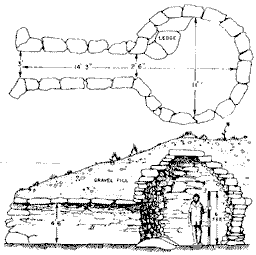 The dry masonry chamber at Upton, Massachusetts. (Adapted from ESRS Bulletin, 1:12, 1973) |
- The sophisticated corbelling of the structure closely follows that seen in Irish and Iberic chambers, such as New Grange.
- The long passageway is aligned with the summer solstice sunset, also a feature of some ancient European structures, but hardly of any concern to a New England farmer.
- The Upton chamber seems to be associated with linear arrays of stones and stone cairns on nearby Pratt Hill. These alignments have obvious astronomical significance. In fact, based upon changes in the setting positions of several stars (due to precession), Mavor and Dix believe the whole complex dates back to 700-750 AD. They conclude:
"Of all the enigmatic structures that we have seen in America, the Upton chamber stands out as one that could have been built under the influence of Irish monks in the 8th century."
(Mavor, James W., Jr., and Dix, Byron E.; "Earth, Stones. and Sky: Universality and Continuity in American Cosmology," NEARA Journal, 29:91, 1995. NEARA = New England Antiquities Research Association)
From Science Frontiers #103, JAN-FEB 1996. � 1996-2000 William R. Corliss