
Home Page Science Frontiers
ONLINE

No. 80: Mar-Apr 1992

Issue Contents


Other pages


Other Interesting Sites


Possible Chain Of Meteorite Scars In Argentina
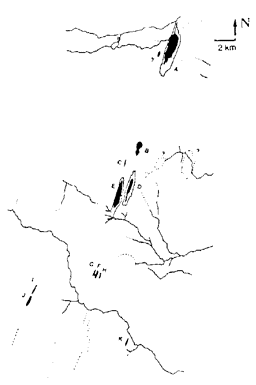
String of linear depressions characterizing the Rio Cuarto crater field
A string of linear depressions characterizes the Rio Cuarto crater field
In the January 16, 1992, issue of Nature, P.H. Schultz and R.E. Lianza describe a curious chain of grooves incised in the Argentine pampas near Rio Cuarto.

"During routine flights two years ago ..., one of us (R.E.L.) noticed an anomalous alignment of oblong rimmed depressions (4 km x 1 km) on the otherwise featureless farmland of the Pampas of Argentina. We argue here, from sample analysis and by analogy with laboratory experiments, that these structures resulted from lowangle impact and ricochet of a chondritic body originally 150-300 m in diameter."

There are ten gouges in all, strung out along 50 kilometers. The scars are young, perhaps only a few thousand years old, well within the time of human habitation. Schultz and Lianza also found pieces of meteoritic rock and glassy fragments of impact melt.

(Schultz, Peter H., and Lianza, Ruben E.; "Recent Grazing Impacts on the Earth Recorded in the Rio Cuarto Crater Field, Argentina," Nature, 355:234, 1992. Also: Monastersky, R.; "Meteorite Hopscotched across Argentina," Science News, 141:55, 1992.)

Comments. Note the similarities to the much more numerous Carolina Bays. See ETB1 in our catalog: Carolina Bays, Mima Mounds, Submarine Canyons. For ordering information, see: here.

More recently, doubts have been raised concerning the meteoric origin of these scars.

From Science Frontiers #80, MAR-APR 1992. © 1992-2000 William R. Corliss

Science Frontiers Sourcebook Project Reviewed in:

Quotes

  • "A sourcebook of unexplained phenomena is therefore a valuable addition to a collection of scientific literature. William R. Corliss has provided this in the past with his source books of scientific anomalies in several subjects, and now he has provided it for astronomy. He has done an excellent job of collecting and editing a large amount of material, taken in part from scientific journals and in part from scientific reporting in the popular or semi-scientific press." -- "The Mysterious Universe: A Handbook of Astronomical Anomalies", reviwed by Thomas Gold, Cornell University, in Icarus, vol.41, 1980

  • "An interesting, systematic presentation of unusual weather [..] This book is recommended for a general audience" --"Corliss, William R., Tornados, Dark Days, Anomalous Precipitation, and Related Weather Phenomena, Sourcebook Project, 1983.", revieweed in Choice, September 1983
  • "..the science is necessarily somewhat speculative, but Corliss's symthesis is based on reputable sources." -- "Corliss, William R. (Compiler). Lightning, Auroras, Nocturnal Lights, and Related Luminous Phenomena" reviwed by Joseph M. Moran, Univ. of Wisconsin in Science Books and Films, Sep/Oct 1983

  • "Before opening the book, I set certain standards that a volume which treads into dangerous grounds grounds like this must meet. The author scrupulously met, or even exceeded those standards. Each phenomenon is exhaustively documented, with references to scientific journals [..] and extensive quotations" -- "Book Review: The moon and planets: a catalog of astronomical anomalies", The Sourcebook Project, 1985., Corliss, W. R., Journal of the Royal Astronomical Society of Canada, Vol. 81, no. 1 (1987), p. 24., 02/1987