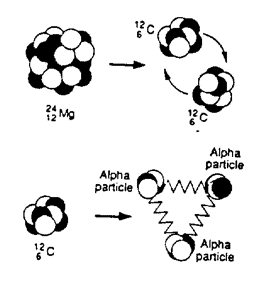
Possible "nuclear-molecular" forms of magnesium-24 and carbon-12.
Inside the atom. Physicists have long visualized the atomic nucleus as being a shell-like arrangement of its constituent protons and neutrons. Tantalizing experiments suggest other wise. Magnes ium-24, for example, may under some circumstances exist as two carbon-12 nuclei in tight orbit, as in the illustra tion. Even more startling is the "sausage" form of magnesium-24, in which six helium-4 nuclei (alpha particles) are lined up in a row. This "hyperdeformed" state has not yet been detected in the lab, but it demonstrates new thinking among the physicists.
(Kenward, Michael; "Are Atoms Composed of Molecules?" New Scientist, p. 21, April 6, 1991.)
Comment. Evidently we do not know everything about nuclear physics.
Beyond the molecule. We are used to seeing atoms and molecules arranging themselves into mathematically regular crystals. Now it appears that particles consisting of thousands of atoms also spontaneously organize themselves.
A.S. Edelstein et al find that molybdenum particles assemble themselves in cubes with two prominent edge lengths: 4.8 and 17.5 nanometers. The larger cubes show up in micrographs as 3x3x3 groupings of the smaller cubes. The smaller cubes each contain about 7000 atoms.
(Edelstein, A.S., et al; "Self Arrangement of Molybdenum Particles into Cubes," Science, 251:1590, 1991.)
Comment. What are the "organizing forces" here? Why cubes? Why the heirarchy of cubes? Why 3x3x3 super cubes?
"Before opening the book, I set certain standards that a volume which treads into dangerous grounds grounds like this must meet. The author scrupulously met, or even exceeded those standards. Each phenomenon is exhaustively documented, with references to scientific journals [..] and extensive quotations" -- "Book Review: The moon and planets: a catalog of astronomical anomalies", The Sourcebook Project, 1985., Corliss, W. R., Journal of the Royal Astronomical Society of Canada>, Vol. 81, no. 1 (1987), p. 24., 02/1987