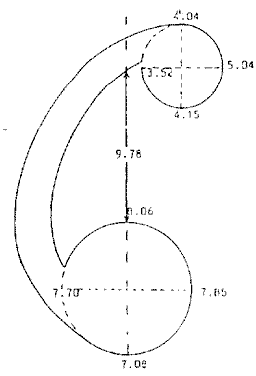
The Wiltshire crop "scroll". Dimensions in meters.
Every week, it seems, some new facet of the crop circle phenomenon appears. It is reminiscent of the early days of UFOs. Several books have appeared. A periodical, The Cereologist, now promises to keep everyone up-to-date. People are scouring the old literature and pouring over aerial photos for pre-1980 examples. Theories abound, especially those invoking extraterrestrials!
We have room here for only a few brief items.
Scorched earth in Xenia, Ohio. A hired hand of Gene Eck was harvesting a field of soybeans when he came upon a circle of flattened plants -- bent but not broken -- some 80 feet in diameter. Inside this circle was a 40-foot-diameter ring of burnt stubble. Within the ring was a patch of undisturbed foxtail 14 feet in diameter. The soybean circle was a half mile from the nearest road; no tracks led into it.
(Williams, Nat; Illinois Agri-News,
November 9, 1990. Cr. R.A. Ford)
Column of light in Wiltshire. During the summer of 1990, teams of English ob servers scanned the cereal fields at night. At 2:30 AM, on July 25, R. Fla-herty, an experienced wildlife photographer, saw a single shaft of light descending from high in the sky toward a Wiltshire wheat field. Flaherty's view of the field itself was cut off by a ridge, so he could provide no further data. When morning came, as you probably surmised, the field displayed flattened wheat -- not the run-of-the-mill circles, but a scroll of sorts and even a triangle with rounded corners.
(Meaden, G.T.; "The Beckhampton 'Scroll-Type' Circles, the Beckhampton 'Triangle,' and Strange Attractors," Journal of Meteorology, U.K., 15:317, 1990.)
Comment. Could the English column of light have been created by the same force that made the Ohio burnt circle?
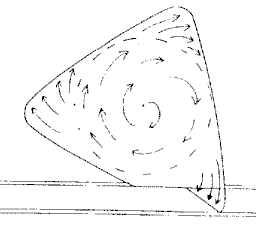
The "triangle" nearby. The sides are 10-11 meters long.
Des Ronds dans le Ble. Yes, the French are chasing crop circles, too. In fact, a team of 8 French observers (designated VECA 90) spent the summer of 1990 in England. After watching by night without success, reviewing the English data, they finally discovered the secret ("ils ont finalement decouvert le pot aux roses"). The crop circles and all the elaborate designs are man-made! In fact the French team demonstrated how one could quickly make circles and more complex designs with a garden roller. Case closed!?
(Pinvidic, Thierry; "L'Histoire Folle des Ronds dans le Ble," Science et Vie, no 878, p. 28, November 1990. Cr. C. Mauge.)
Comment. That all crop circles are manmade is debatable, certainly many are, and one can make a case for a meteor ological origin for the simpler geometries. One English contact states firmly that a review of old aerial photographs found no complex patterns at all. But who knows what next week's mail will bring?
"A sourcebook of unexplained phenomena is therefore a valuable addition to a collection of scientific literature. William R. Corliss has provided this in the past with his source books of scientific anomalies in several subjects, and now he has provided it for astronomy. He has done an excellent job of collecting and editing a large amount of material, taken in part from scientific journals and in part from scientific reporting in the popular or semi-scientific press." -- "The Mysterious Universe: A Handbook of Astronomical Anomalies", reviwed by Thomas Gold, Cornell University, in Icarus, vol.41, 1980
"An interesting, systematic presentation of unusual weather [..] This book is recommended for a general audience" --"Corliss, William R., Tornados, Dark Days, Anomalous Precipitation, and Related Weather Phenomena, Sourcebook Project, 1983.", revieweed in Choice, September 1983
"..the science is necessarily somewhat speculative, but Corliss's symthesis is based on reputable sources." -- "Corliss, William R. (Compiler). Lightning, Auroras, Nocturnal Lights, and Related Luminous Phenomena" reviwed by Joseph M. Moran, Univ. of Wisconsin in Science Books and Films, Sep/Oct 1983
"Before opening the book, I set certain standards that a volume which treads into dangerous grounds grounds like this must meet. The author scrupulously met, or even exceeded those standards. Each phenomenon is exhaustively documented, with references to scientific journals [..] and extensive quotations" -- "Book Review: The moon and planets: a catalog of astronomical anomalies", The Sourcebook Project, 1985., Corliss, W. R., Journal of the Royal Astronomical Society of Canada, Vol. 81, no. 1 (1987), p. 24., 02/1987