Home Page Science Frontiers
ONLINE

No. 70: Jul-Aug 1990

Issue Contents


Other pages


.


Wandering Albatrosses Really Wander

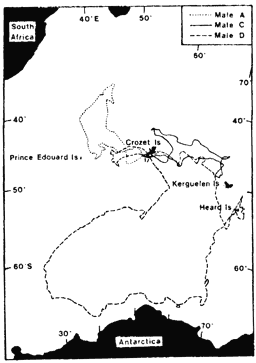
Tracks of three Wandering albatrosses in the southern Indian Ocean
Tracks of three Wandering albatrosses in the southern Indian Ocean.
Six male wandering albatrosses nesting on Crozet Island, between South Africa and Antarctica, were fitted with tiny (180-gram) transmitters and tracked by satellite. Their flights were amazing:

"Tracks of wandering albatrosses in the southwestern Indian Ocean showed that they covered between 3,600 and 15,000 km in a single foraging trip during an incubation shift. They flew at speeds of up to 80 km per h and over distances of up to 900 km per day. They remained active at night, particularly on moonlit nights..."

(Jouventin, Pierre, and Weimerskirch, Henri; "Satellite Tracking of Wandering Albatrosses,; Nature, 343:746, 1990.)

From Science Frontiers #70, JUL-AUG 1990. © 1990-2000 William R. Corliss

Science Frontiers Sourcebook Project Reviewed in:

Quotes

  • "Before opening the book, I set certain standards that a volume which treads into dangerous grounds grounds like this must meet. The author scrupulously met, or even exceeded those standards. Each phenomenon is exhaustively documented, with references to scientific journals [..] and extensive quotations" -- "Book Review: The moon and planets: a catalog of astronomical anomalies", The Sourcebook Project, 1985., Corliss, W. R., Journal of the Royal Astronomical Society of Canada>, Vol. 81, no. 1 (1987), p. 24., 02/1987