 |
Science Frontiers ONLINE No. 69: May-Jun 1990 |
|
| 
|
The enigmatic "mooring stones"
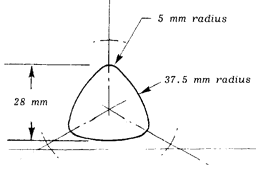 Cross-section of a "mooring stone" hole |
The holes are made with high precision to the dimensions shown in the figure. They are 6 inches deep, plus or minus an inch. Holes with a rounded triangular shape represent a sophisticated drilling technology. Steel tools are high craftsmanship are indicated.
Even though the holes have been known for over a century, only amateurs have shown much interest. A few such enthusiasts have tracked down hundreds in Minnesota, North Dakota, South Dakota, Illinois, and the eastern seaboard. All of them seem to be located on present-day lakes and rivers and now-dry waterways. This marine affinity has led to the theory that they are "mooring stones," especially Viking mooring stones! In truth their real purpose is unknown.
How old are the holes? Weathering of those in granite suggest ages of at least several hundred years - well before the westward push of American settlers. The peculiar shape of the holes seems to rule out production by modern drills (usually round) for purposes of blasting or installation of surveyors' markers.
Another puzzle, probably related to the purpose of the holes, is the presence of large, smooth grooves on some of the boulders bearing the triangular holes.
The technique of "cam wedging" may lead us to the purpose of the holes. If one inserts a triangular shaft into such a hole and rotates it part of a turn, the shaft becomes firmly wedged in place. A rotation in the opposite direction quickly frees the shaft. It does seem that the mooring-stone hypothesis is consistent with cam-wedging.
(Olson, John J.; "'Mooring Stones': An Enigma Deserving More Attention," Epigraphic Society, Occasional Publications, 18:253, 1989.)
Comment. Before climbing on the Viking bandwagon, it is reasonable to ask whether the Vikings drilled the same holes in Europe.