 |
Science Frontiers ONLINE No. 64: Jul-Aug 1989 |
|
| 
|
The 1977 "wow" signal
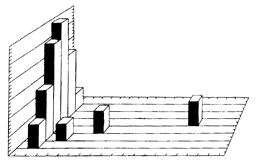 Anatomy of a "WOW" signal. Vertical ordinate represents intensity; horizontal axis is frequency in intervals of 10 kilohertz. Time axis runs into the chart with 12-second intervals. |
There have been a few exciting false alarms during these listening periods, but most could be attributed to known natural radio sources or manmade interference. All in all, it has been rather disappointing to those who are sure someone else is out there.
The major exception in the SETI record was the so-called "WOW" (like Egad!) signal picked up in 1977 by a radio telescope at Ohio State University, in Columbus. The bandwidth of the sig nal was narrower than those of most natural sources; there was also some evidence of periodic and drifting features. The signal never recurred, nor could it be correlated with any manmade or natural radio sources.
(Eberhart, Jonathan; "Listening for ET," Science News, 135:296, 1989.)
Comment. We can only speculate as to what alien intelligence might mean. Then, too, aliens have probably progressed far beyond primitive radio communication!