 |
Science Frontiers ONLINE No. 63: May-Jun 1989 |
|
| 
|
More confusion at the k-t boundary
Just a few years ago, many scientists, especially physicists and astronomers, considered the Book of Science to be closed in the matter of what happened at the Cretaceous-Tertiary (K-T) boundary, 65 million years ago, and why the dinosaurs met their end. It was declared, rather imperiously, that a large asteroid had impacted the earth, causing much physical and biological devastation. Many scientific papers are still being written on this singular period in the earth's history, and the situation is no longer so clear-cut. We select for brief review four papers, each with a different perspective.
Occurrence of stishovite. Stishovite, a dense phase of silica, is widely accepted as an indicator of terrestrial impact events. It is not found at volcanic sites. Now, J.F. McHone et al report its existence at the K-T boundary, at Raton, New Mexico. (McHone, John F., et al; "Stishovite at the CretaceousTertiary Boundary, Raton, New Mexico," Science, 243:1182, 1989.) A plus for the pro-impact side.
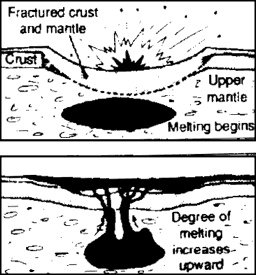 The impact of an asteroid can initiate basaltic flooding and trap formation. |
The evidence of the traps. Traps, like India's famous Deccan Traps, are extensive flood basalts. In this paper, basalt flooding has been correlated with mass extinctions of marine life during the past 250 million years. The Deccan Traps were formed right at the K-T boundary. Traps could, however, be initiated by asteroid impact, which could stimulate eruptions. (Rampino, Michael; "Dinosaurs, Comets and Volcanoes," New Scientist, p. 54, February 18, 1989.)
The dinosaur angle. If dinosaurs were truly susceptible to extinction by either asteroid impact, widespread volcanism, or some combination of both, one would expect to find their numbers and diversity drastically curtailed during Mesozoic impact events. Instead, the dinosaurs not only survived these impacts but prospered. Their demise, which began before the K-T event, was probably not due to either impact or vol canism. (Paul, Gregory S.; "Giant Meteor Impacts and Great Eruptions: Dinosaur Killers?" BioScience, 39:162, 1989.)
Reference. Impact craters and stratigraphic evidence of catastrophism are cataloged in: Carolina Bays, Mima Mounds and Anomalies in Geology, respectively. For information on these catalogs, visit: here.