 |
Science Frontiers ONLINE No. 53: Sep-Oct 1987 |
|
| 
|
Lenses In Antiquity
The ancient Greeks seem to have thought of just about everything. True, they didn't conceive of silicon chips or H-bombs, but they did know rudimentary optics. Excavations down the years have yielded hundreds of lenses ground from quartz crystals. (Later, the Romans used glass.) Many of these early lenses were articles of high craftsmanship, being accurately spherical and wellpolished. Lathes were evidently available for grinding the rock crystal into appropriate shapes. Some ancient lenses had holes drilled through them, possibly so that they could be carried around the neck on cords. These seem to have been used for kindling fires. Most lenses, though, were probably magnifiers for authenticating seals and for carving gems.
(Sines, George, and Sakellarakis, Yannis A.; "Lenses in Antiquity," American Journal of Archaeology, 91:191, 1987.)
Comment. We wonder if any ancient Greeks ever put two of these lenses together to make a telescope. Such a tan dem arrangement of lenses seems such a natural experiment; i.e., if one is good, two will be better!
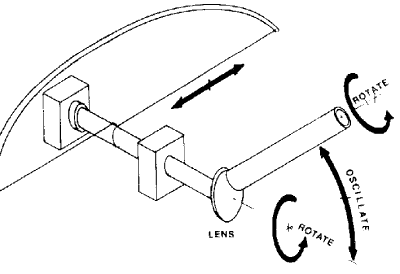 | The ancients probably ground lenses with the aid of bow-driven spindles. |