 |
Science Frontiers ONLINE No. 42: Nov-Dec 1985 |
|
| 
|
Great pyramid entrance tunnel not astronomically aligned
Early in the Nineteenth Century, astronomer John Herschel speculated that the ancient Egyptians had constructed the Great Pyramid so that the downwardly slanting entrance would be aligned precisely with the pole star, Thuban (Alpha Draconis), when the star was at its lowest culmination. Over 70 years ago Percival Lowell ran through the calculations and found that Thuban was not near the tunnel's line of sight when the pyramid was constructed (about 2800 BC). No one seems to have listened to Lowell, even though he was quite correct. Most books on the Great Pyramid still insist on the fancied pole star alignment.
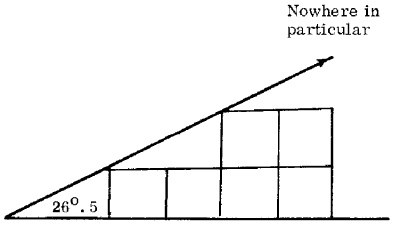
If the entrance tunnel wasn't pointing at the pole star, what other esoteric reason did the pyramid builders have for the 26�.523 angle? (It seems that everyone expects all dimensions of the Great Pyramid to have special significance.) R.L. Walker, of the Naval Observatory, has come to the rescue. He observes that the tangent of 26�.523 is almost exactly (actually 0.4991). Although there may be some occult significance to �, this fraction also signals to us that 26�.523 is also the angle created when two cubical blocks are laid horizontally for every one installed vertically, as in the sketch. It seems that 26�.523 is simply the natural consequence of the internal pyramid construction process.
(Anonymous; "End of a Pyramid Myth," Sky and Telescope, 69:496, 1985.)
Comment. P. Lowell also showed that Thuban did cross the tunnel entrance centuries before and after the accepted date of construction. Could the date of the pyramid be in error, or were the builders planning for the future? Anything is possible in Pyramidology!
Reference. Pyramid puzzles of all types are described in the handbook: Ancient Man. To order, visit: here.