 |
Science Frontiers ONLINE No. 41: Sep-Oct 1985 |
|
| 
|
Anatomy Of A Magnetic Field Reversal
"A highly detailed record of both the direction and intensity of the Earth's magnetic field as it reverses has been obtained from a Miocene volcanic sequence. The transitional field is low in intensity and is typically non-axisymmetric. Geomagnetic impulses corresponding to astonishingly high rates of change of the field sometimes occur, suggesting that liquid velocity within the Earth's core increases during geomagnetic reversals."
The time period required for the field to reverse was about 4500 years, as measured at Steens Mountain, Oregon. There were three periods of very rapid change (impulses), which hint at radical changes in the core. The average magnetic field at the earth's surface decreased to 20% of normal during the reversal.
(Prevot, Michel, et al; "How the Geomagnetic Field Vector Reverses Polarity," Nature, 316:230, 1985.)
Comment. The illustration reveals that the reversal was far from a clean 180� flip; there was much meandering. Just what was happening in the core during the reversal is a mystery. When the magnetic field dropped to low levels, flux of cosmic rays and other radiation at the earth's surface probably increased drastically. Terrestrial life might have been adversely affected.
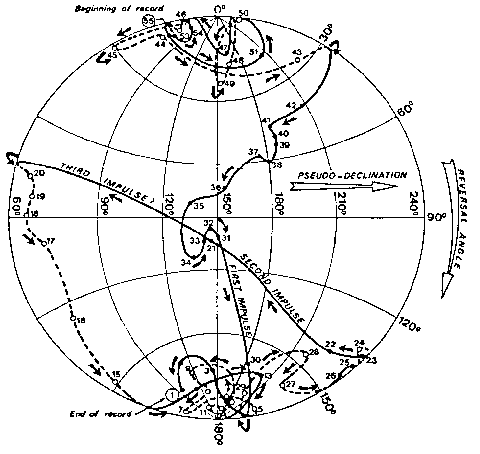 | The Steene Mountains directional record. The numbers refer to the samples used from the volcanic sequence, in order of increasing age. Dotted lines represent field directions in the opposite hemisphere. |