 |
Science Frontiers ONLINE No. 34: Jul-Aug 1984 |
|
| 
|
Our aquatic phase!
Elaine Morgan, author of The Aquatic Ape, reviews new evidence supporting the Aquatic Ape Hypothesis. Sir Alister Hardy suggested this hypothesis in 1960 in an attempt to account for several human characteristics that are unique among primates but common in aquatic mammals. Some of these are: position of fetal hair, loss of body hair, subcutaneous fat, face-to-face copulation, weeping, etc. The combination of hairlessness and subcutaneous fat seems almost totally confined to aquatic mammals and humans.
Two other characteristics are covered in some depth in this article:
- The discovery that some prehistoric shell middens consist of deep-water shellfish, which must be the result of breath-held diving. This human skill, again unique among primates, is obviously quite ancient. Furthermore, recent experiments suggest that in humans, in addition to seals and ducks, vascular constriction is not limited to the arterioles but extends to the larger arteries, too. This indicates some degree of specialized adaptation to a diving life.
- Most animals with a sodium deficiency display an active craving for salt which, when satisfied, disappears. In humans, salt intake has little or no relation to the body's needs. Some Inuit tribes avoid salt almost completely, while people in the Western world consume 1520 times the amount needed for health. In other works, a single African species (assuming humans have an African origin) possesses a wildly different scheme of salt management. Humans are also the only primates to regulate body temperature by sweat-cooling, a system profligate in the use of sodium. Proponents of the Aquatic Ape Hypothesis believe that sweat-cooling could not have developed anywhere except near the sea where diets contain considerable salt, in fact much more salt than the body requires.
This article also deals with certain skeletal features of early man that seem to indicate an aquatic stage. For example, the Lucy skeleton has a shoulder joint that indicates that Lucy spent a lot of time with her hands above her head, as she would have if aquatic or treeswinging!
(Morgan, Elaine; "The Aquattic Hypothesis," New Scientist, p. 11, April 12, 1984.)
Reference. Many phenomena presented in our Catalog Biological Anomalies: Humans I are favorable to the Aquatic Ape Hypothesis. This book is described here.
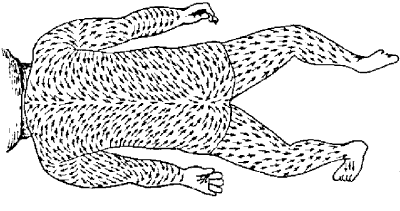 | Hair tracts on a human foetus that seem to indicate water-flow patterns (From Incredible Life). |