
Home Page Science Frontiers
ONLINE

No. 30: Nov-Dec 1983

Issue Contents


Other pages


.


THE AORTIC ARCH AND EVOLUTION

Comparative anatomy is supposed to tell us which creatures are closely related so that we can draw those familiar evolutionary family trees. That anatomical similarities may be misleading is proved by the various configurations of the mammalian aortic arch -- certainly one of the major body structures. Five prin-cipal configurations of mammalian aortic arches are sketched in the accompanying figure. The species possessing these various configurations make kindling of the usual evolutionary family trees.
  1. Horses, pigs, deer;
  2. Whales, shrews;
  3. Marsupials, rats, dogs, apes, monkeys;
  4. The platypus, sea cows, some bats, humans;
  5. African elephants, walruses.

(Davidheiser, Bolton; "The Aortic Arch," Creation Research Society Quarterly, 20:15, 1983.)

Comment. On this basis alone, humans are more closely related to sea-cows than the apes. Why aren't such discrepancies highlighted in the mainstream scientific literature?
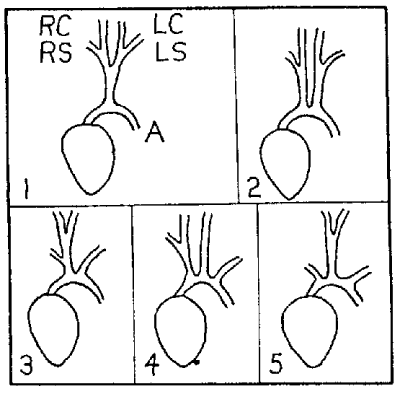
Mammalian aortic arch in the heart Mammalian aortic arch . The key is as follows: RC: right carotid; LC: left carotid; RS: right subclavian; LS: left subclavian; A: aorta. The kinds of animal which have various arrangements are mentioned in the text.

From Science Frontiers #30, NOV-DEC 1983. © 1983-2000 William R. Corliss

Science Frontiers Sourcebook Project Reviewed in:

Quotes

  • "Before opening the book, I set certain standards that a volume which treads into dangerous grounds grounds like this must meet. The author scrupulously met, or even exceeded those standards. Each phenomenon is exhaustively documented, with references to scientific journals [..] and extensive quotations" -- "Book Review: The moon and planets: a catalog of astronomical anomalies", The Sourcebook Project, 1985., Corliss, W. R., Journal of the Royal Astronomical Society of Canada>, Vol. 81, no. 1 (1987), p. 24., 02/1987