 |
Science Frontiers ONLINE No. 20: Mar-Apr 1982 |
|
| 
|
Gravity Anomaly Ripples Centered In Canada
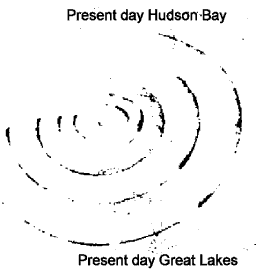
When scientists recently examined gravity anomaly data for North America, strange circular ripples appeared to surround a point near Hudson Bay. These ripples seem to have spread out like those from a pebble dropped into a pond, but here the ripples are actually ancient density variations in the earth's crust, now covered over by thick sediments. One hypothesis is that a 60-90 kilometer meteorite smashed into the earth some 4 billion years ago, wrinkling the young surface for several thousand kilometers in all directions around a colossal crater. Magma welling up in the crater solidified creating the nucleus of the North American continent. It is quite possible that the other continents began their existences in this way -- meteor impact. The gravity data that led to this hypothesis have been available for some time but apparently no one ever looked at them with continental patterns in mind.
(Simon, C.; "Deep Crust Hints at Meteoric Impact," Science News, 121:69, 1982.)
Comment 1: John Saul has discovered surface indications of immense ring structures in the American southwest. See ETC2 in our Catalog: Carolina Bays, Mima Mounds, which is described more fully here.
Comment 2: If all our continents were initiated by meteor impacts, and if they were once clustered together in a supercontinent, as postulated by Continental Drift, then the incoming meteorites would have to have been focussed on a restricted portion of the earth's surface; that is, where the supercontinent was formed prior to continental drift. Several solar system bodies show just such preferential cratering on one hemisphere.