
Home Page Science Frontiers
ONLINE

No. 20: Mar-Apr 1982

Issue Contents


Other pages


.


Heads or tails?

Fake-head butterflies often escape predators that make passes at their cleverly designed tails, which as the figure shows, look awfully like butterfly heads, with eye spot, fake antennas, etc. Further, the converging stripes direct attention to the false head. The result is that this type of butterfly may lose its tail but save its real head. This effective stripe pattern has evolved (?) independently at least six times in the Neotropics.

(Robbins, Robert K.; "The 'False Head' Hypothesis: Predation and Wing Pattern Variation of Lycaenid Butterflies," American Naturalist, 118:770, 1981.)

Comment. One wonders why all butterflies haven't evolved this neat ploy?
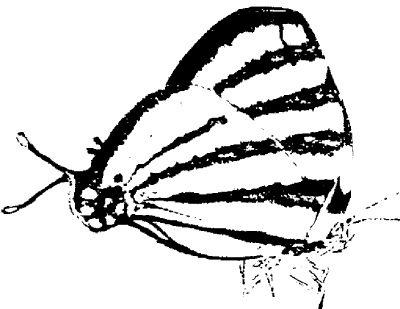
Fake-head butterfly

From Science Frontiers #20, MAR-APR 1982. © 1982-2000 William R. Corliss

Science Frontiers Sourcebook Project Reviewed in:

Quotes

  • "Before opening the book, I set certain standards that a volume which treads into dangerous grounds grounds like this must meet. The author scrupulously met, or even exceeded those standards. Each phenomenon is exhaustively documented, with references to scientific journals [..] and extensive quotations" -- "Book Review: The moon and planets: a catalog of astronomical anomalies", The Sourcebook Project, 1985., Corliss, W. R., Journal of the Royal Astronomical Society of Canada>, Vol. 81, no. 1 (1987), p. 24., 02/1987