 |
Science Frontiers ONLINE No. 18: Nov-Dec 1981 |
|
| 
|
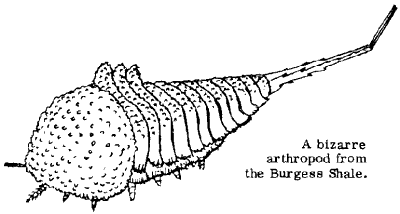
The Burgess Shale Puzzle
In British Columbia, a middle Cambrian (550 million years BP) formation called the Burgess Shale has miraculously preserved a vast assemblage of soft-bodied sea creatures, especially arthropods. Does this rich and unusual deposit help elucidate arthropod evolution? No, it has complicated the problem. Few of the fossil arthropods can be easily related to groups now living. The Burgess Shale arthropod population is primitive in some ways but remarkably specialized in others. Some of the fossils have body segments like those in one recognized arthropod group but display limbs resembling those of an entirely different group.
(Fortey, R.A.; "The Burgess Shale: A Unique Cambrian Fauna," Nature, 293: 189, 1981.)
Comment. It appears that Nature was shuffling the gene deck, or that there was rampant hybridization, or that confusing programs for evolutionary change were drifting in from the cosmos a la Hoyle and Wickramasinghe!
 |