
Why Birds Are Pretty
Darwin believed that many male birds are brightly colored because females prefer flashy finery and thus put evolutionary pressure on the development of these characteristics. A large-scale study by Baker and Parker indicates that Darwin erred and that the evolutionary pressure comes instead from predators avoiding brightly colored targets. Instinct tells the predators -- incorrectly in many cases -- that colorful prey taste bad or are noxious.
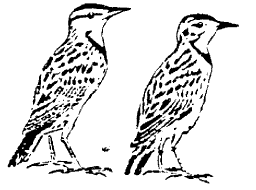
The remarkable (possibly strange) aspect of bird coloration is the incredi ble external similarity of unrelated birds occupying similar habitats. Example, the American Eastern Meadowlark (left) closely resembles the African Yellowthroated Longclaw (right).
(Krebs, John R.; "Bird Colours," Nature, 282:14, 1979.)
Comment. Two questions cannot be repressed: How do the genes orchestrate this amazing convergence in response to environmental factors? Why was evolution not equally clever in equipping predators with countermeasures to see through these ruses?